


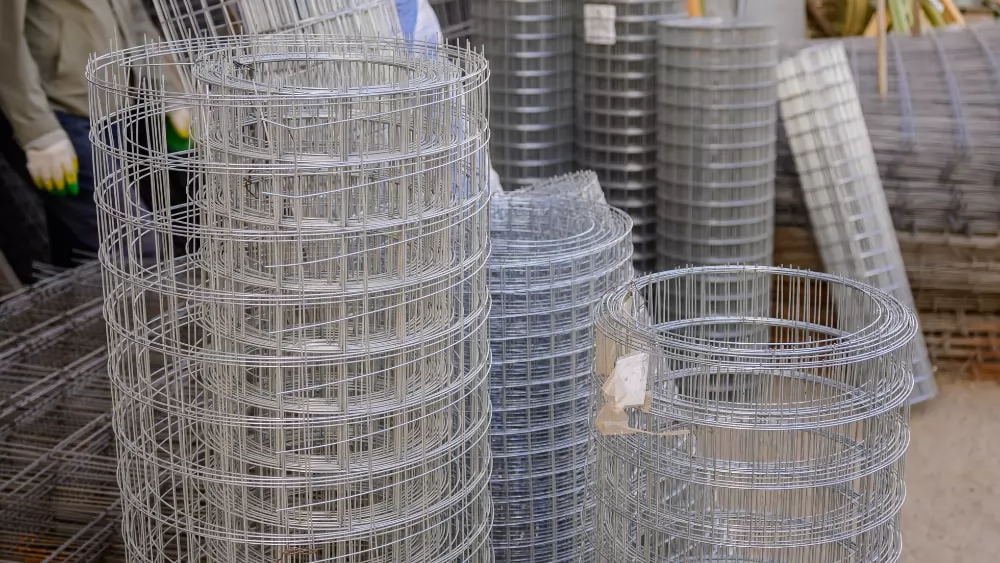
Whether you are planning a garden fence, reinforcing a concrete slab, or building an animal enclosure, you have probably come across the term weld mesh. But what exactly is it, and how do you know which type is right for your project? This guide covers everything you need to know — from how it is made to how to choose the correct size.
1. What is Weld Mesh?
Weld mesh — also written as weldmesh and formally known as welded wire mesh or welded wire fabric — is a prefabricated grid structure made from metal wires arranged in rows and columns at right angles, then permanently fused together at every intersection point using electric resistance welding. The result is a rigid, stable panel or roll of mesh with uniform, evenly spaced openings.
Because the wires are welded rather than woven or interlocked, weld mesh holds its shape under load and does not unravel when cut. This makes it one of the most versatile and widely used materials in construction, agriculture, industrial safety, and landscaping worldwide.
Quick definition: Weld mesh is a grid of metal wires, welded at every crossover point, available in panels or rolls, and used in applications ranging from concrete reinforcement and garden fencing to animal enclosures and machine guarding.
2. How is Weld Mesh Made?
Weld mesh is produced on automated welding machines that handle the entire process with high dimensional precision. The manufacturing sequence follows these steps:
- Wire preparation: Steel wire is drawn from coils to the required diameter and straightened by passing through a series of rollers.
- Grid alignment: Longitudinal wires (running the length of the mesh) are fed into the machine at fixed, even spacing. Transverse wires (cross wires) are then laid perpendicular on top at equally spaced intervals.
- Electric resistance welding: Copper electrodes clamp down on every intersection simultaneously and deliver a precisely controlled surge of electrical current. The heat generated fuses the two wires together without any filler material, creating a strong metallurgical bond.
- Cutting and forming: The continuous mesh sheet is cut to the required panel length, or wound onto rolls for transport.
- Surface treatment (optional): Depending on the product specification, the finished mesh may be hot-dip galvanized, electro-galvanized, or PVC-coated to improve corrosion resistance and service life.
This automated process produces consistent mesh with accurate wire spacing, uniform weld strength, and minimal waste — advantages that make factory-produced weld mesh more reliable and cost-effective than on-site fabrication.
3. Types of Weld Mesh
Weld mesh is classified primarily by its surface treatment and material. Choosing the right type depends on the environment the mesh will be used in and the level of corrosion resistance required.
3.1 Galvanized Weld Mesh
Galvanized weld mesh is coated with a protective layer of zinc, which acts as a physical barrier against moisture and oxidation. There are two galvanizing methods:
- Hot-dip galvanized: The finished mesh is immersed in molten zinc at around 450°C. This creates a thicker, more durable coating and is the preferred choice for outdoor applications.
- Electro-galvanized: Zinc is applied via an electrochemical process, producing a thinner, smoother finish. More suitable for indoor use or light-duty outdoor applications.
Best for: Garden fencing, agricultural enclosures, construction reinforcement, drainage covers, and general outdoor use. A hot-dip galvanized mesh can last 15 to 25 years with minimal maintenance.
3.2 PVC-Coated Weld Mesh
PVC-coated weld mesh starts with a galvanized wire core and adds a polyvinyl chloride outer layer applied by an automatic extrusion process. The PVC coating provides additional corrosion protection, improves the mesh's appearance, and softens its edges. It is available in several standard colours, most commonly green, black, and white.
Best for: Residential garden fencing, property boundaries, pet enclosures, and anywhere that appearance matters alongside functionality.
3.3 Stainless Steel Weld Mesh
Made from stainless steel wire, typically grade 304 (general-purpose corrosion resistance) or grade 316 (enhanced resistance to chlorides and marine environments), this is the premium option. Stainless steel weld mesh does not rust, is non-reactive with most chemicals, and is suitable for food-contact applications.
Best for: Food processing equipment, pharmaceutical production, marine environments, architectural facades, and chemical processing screens where long-term hygiene and corrosion resistance are critical.
3.4 Plain Steel (Black) Weld Mesh
Produced from mild steel wire with no protective coating, plain or "black" weld mesh is the most economical option. It is suitable for short-term or temporary applications, indoor use, or situations where the mesh will be painted or embedded in concrete where surface corrosion is not a concern.
Best for: Concrete reinforcement (where it will be fully encased), temporary construction barriers, and projects where cost is the primary consideration.
Quick Comparison Table
| Type | Corrosion Resistance | Lifespan (Outdoor) | Cost Level | Typical Use |
|---|---|---|---|---|
| Hot-Dip Galvanized | High | 15–25 years | Medium | Fencing, construction, agriculture |
| Electro-Galvanized | Medium | 5–10 years | Low–Medium | Indoor/light outdoor use |
| PVC-Coated | High | 20+ years | Medium–High | Residential fencing, garden, pets |
| Stainless Steel | Very High | Decades | High | Food, marine, industrial, architectural |
| Plain Steel (Black) | Low | 1–3 years | Low | Concrete reinforcement, temporary use |
4. What is Weld Mesh Used For?
Weld mesh is one of the most adaptable building and engineering materials available. Below are the most common applications, each with specific requirements that influence the type and specification of mesh to select.
4.1 Concrete Reinforcement
In construction, weld mesh — often called reinforcing mesh or reo mesh — is laid within concrete slabs, floor screeds, pavements, and retaining walls before the concrete is poured. The mesh distributes tensile stress across the concrete, preventing cracking caused by shrinkage, thermal movement, or structural loading. It offers a faster and more uniform alternative to placing individual rebar. Standard mesh for floor slabs typically uses a 200×200mm aperture with a 4–6mm wire diameter.
4.2 Garden and Property Fencing
Weld mesh fencing is a popular choice for marking property boundaries, enclosing gardens, and creating secure perimeters for commercial and residential sites. Unlike chain link, welded panels are rigid and maintain their shape, making them harder to push through or climb. PVC-coated versions in green or black blend discreetly into garden settings.
4.3 Animal Enclosures
From backyard chicken coops to large-scale livestock fencing, weld mesh is the material of choice for animal containment. The aperture size must be carefully matched to the size of the animal: a 25×25mm mesh with 1.2–2mm wire is suitable for poultry and rabbits, while larger livestock enclosures use 100×100mm or wider apertures with 3–4mm wire for strength.
4.4 Industrial Machine Guarding
In manufacturing and warehouse environments, weld mesh panels are used to create safety barriers around hazardous machinery, partition storage areas, and protect personnel from moving parts. The rigid welded structure is resistant to impact and does not flex or deform under repeated contact. Panels are typically framed in steel and bolted into modular guarding systems.
4.5 Security Fencing
High-security applications — airports, prisons, data centres, and utility sites — use heavy-gauge weld mesh with small apertures (typically 76.2×12.7mm, known as 358 anti-climb mesh) that make it extremely difficult to cut with standard tools or gain a foothold for climbing.
4.6 Agriculture and Horticulture
Weld mesh supports climbing plants, creates frames for growing structures, protects young trees from deer and rabbits, and forms the structural skeleton of greenhouse benching. Galvanized mesh is the standard here due to its resistance to outdoor moisture and UV exposure.
4.7 Gabion Baskets and Retaining Walls
Gabion baskets — wire cages filled with stone — rely on weld mesh panels as their structural shell. These are used extensively in landscaping, erosion control, riverbank stabilisation, and decorative retaining walls. Heavy-gauge galvanized or PVC-coated mesh is required to withstand the weight and pressure of the stone fill.
4.8 Interior Design and Furniture
Increasingly, weld mesh is used as a decorative and functional element in interior design: as shelving surfaces, wardrobe backing panels, room dividers, radiator covers, and cabinetry inserts. Fine-gauge powder-coated or stainless steel mesh is preferred for these applications.
5. Weld Mesh Sizes & Specifications Explained
Understanding weld mesh specifications is straightforward once you know the three key measurements. Mesh is typically described as, for example, 50×50mm / 2.5mm, which means a 50mm square aperture using 2.5mm diameter wire.
5.1 Aperture (Mesh Opening Size)
The aperture is the clear gap between adjacent wires, measured in millimetres. It is the most important specification for determining suitability:
- Small apertures (≤25mm): Animal containment, security, fine filtration
- Medium apertures (50–75mm): General fencing, garden use, machine guarding
- Large apertures (100mm+): Concrete reinforcement, gabion baskets, livestock fencing
5.2 Wire Diameter (Gauge)
Wire diameter directly determines the strength and weight of the mesh. Thicker wire produces a heavier, more rigid panel with greater load-bearing capacity.
| Wire Diameter | Classification | Typical Application |
|---|---|---|
| 1.0mm – 1.6mm | Light-duty | Small animal cages, plant support, decorative |
| 2.0mm – 2.5mm | Standard | Garden fencing, poultry, general enclosures |
| 3.0mm – 4.0mm | Medium-duty | Security fencing, machine guarding, livestock |
| 4.5mm – 6.0mm+ | Heavy-duty | Concrete reinforcement, gabion baskets, high security |
5.3 Panel and Roll Dimensions
Weld mesh is available in two standard forms:
- Panels (sheets): Rigid, pre-cut to fixed dimensions. Common sizes include 2400×1200mm and 2400×900mm. Easier to handle and install for fencing and guarding applications.
- Rolls: Continuous length wound onto a core, typically 10m, 25m, or 50m long. Widths commonly range from 0.6m to 1.8m. More economical for covering large areas and can be cut to any length on site.
5.4 Quick Specification Selection Guide
| Application | Recommended Aperture | Recommended Wire Diameter | Form |
|---|---|---|---|
| Concrete floor slab reinforcement | 200×200mm | 5mm – 6mm | Panel |
| Garden / property boundary fence | 50×50mm or 75×75mm | 2.5mm – 3.0mm | Panel or roll |
| Chicken run / poultry enclosure | 25×25mm or 50×25mm | 1.2mm – 2.0mm | Roll |
| Rabbit hutch / small animal cage | 13×13mm or 25×25mm | 1.0mm – 1.6mm | Roll |
| Industrial machine guarding | 50×50mm | 3.0mm – 4.0mm | Panel |
| High-security fencing | 76.2×12.7mm (358 mesh) | 4.0mm+ | Panel |
| Gabion basket / retaining wall | 75×75mm or 100×100mm | 3.0mm – 4.0mm | Panel |
| Decorative / interior design | 25×25mm or 50×50mm | 1.2mm – 2.0mm | Panel |
6. Weld Mesh vs. Other Types of Wire Mesh
Weld mesh is often confused with other mesh products. Here is how it compares to the most common alternatives:
Weld Mesh vs. Chain Link Fence
Chain link is made from interlocking spiral wires that form a diamond pattern. It is flexible, relatively easy to install on uneven terrain, and lower in cost. However, it is less rigid than weld mesh, can be pushed out of shape, and is easier to climb. Weld mesh panels are the better choice where security and structural rigidity are priorities.
Weld Mesh vs. Woven Wire Mesh
Woven wire mesh is made by interlacing wires over and under each other without welding. This gives it flexibility and allows it to be rolled up easily. However, it can unravel when cut and lacks the structural rigidity of weld mesh. Woven mesh is preferred for filtration, screening, and sieving applications; weld mesh is preferred for structural and security applications.
Weld Mesh vs. Expanded Metal Mesh
Expanded metal is made from a single sheet of metal that is slit and stretched to create a diamond-patterned mesh. Because it is one continuous piece, it does not have weld joints and is therefore very strong relative to its weight. It is commonly used in walkways, architectural cladding, and ventilation panels, but is less versatile for fencing and reinforcement than weld mesh.
| Property | Weld Mesh | Chain Link | Woven Wire Mesh | Expanded Metal |
|---|---|---|---|---|
| Structure | Welded grid | Interlocked spirals | Woven crossover | One-piece slit & stretch |
| Rigidity | High | Low–Medium | Low | Medium–High |
| Unravels when cut? | No | No | Yes | No |
| Climb resistance | High | Low | Low | Medium |
| Concrete reinforcement | Yes | No | No | Possible |
| Filtration / screening | Limited | No | Yes | Possible |
| Cost (general) | Medium | Low | Low–Medium | Medium |
7. How to Choose the Right Weld Mesh
Selecting the correct weld mesh comes down to answering three straightforward questions before you purchase:
Step 1: Define Your Application
What will the mesh actually do? Containment, reinforcement, security, decoration, and filtration all have different demands. If you need to keep small animals in, aperture size is critical. If you need structural strength for concrete, wire diameter matters most. If the application involves security, both must be considered together.
Step 2: Consider the Environment
Will the mesh be used outdoors or indoors? Is it near the coast or in a high-humidity environment? For outdoor general use, hot-dip galvanized is the minimum requirement. For coastal or marine environments, PVC-coated or stainless steel grade 316 should be specified. For indoor or temporary use, electro-galvanized or plain steel may be sufficient and more economical.
Step 3: Confirm the Specification
Once you know the application and environment, confirm:
- Aperture size: How large can the gaps be without compromising the purpose?
- Wire diameter: How much strength and rigidity do you need?
- Panel or roll: Are you covering a fixed area (panel) or a long run (roll)?
- Quantity: Measure the total area and add 10% for cutting wastage.
If you are unsure, most reputable suppliers will advise on specification given your project description. Always ask for a technical data sheet confirming wire diameter, aperture, panel dimensions, and coating standard before ordering.
8. Frequently Asked Questions
- What is the difference between weld mesh and welded wire mesh?
- There is no difference — they are the same product. "Weld mesh" and "weldmesh" are informal terms used predominantly in the UK, Australia, and South Africa. "Welded wire mesh" and "welded wire fabric" are the more formal technical terms used in specifications and standards, particularly in North America.
- Is weld mesh the same as wire mesh?
- Not exactly. "Wire mesh" is a broad category that includes woven mesh, expanded metal, and welded mesh. Weld mesh is one specific type of wire mesh — the kind where wires are permanently joined at every intersection by welding, making it rigid. Woven wire mesh, by contrast, is flexible and can unravel when cut.
- What size weld mesh do I need for a chicken run?
- For a chicken run, a 25×25mm or 50×25mm aperture with a 1.6–2.0mm wire diameter is recommended. Small apertures prevent chickens from getting their heads stuck and stop predators such as foxes from reaching through. Avoid large-aperture mesh; even small predators like weasels can pass through gaps larger than 25mm.
- What gauge weld mesh is strongest?
- Strength increases with wire diameter. A 6mm diameter wire produces a significantly stronger mesh than 2mm wire. For the highest-strength applications such as high-security fencing or heavy concrete reinforcement, wire diameters of 4–6mm or greater are specified. However, "strongest" must always be considered alongside aperture size — a 6mm wire with a 200mm aperture is weaker in terms of security than a 4mm wire with a 12.7mm aperture.
- How long does galvanized weld mesh last outdoors?
- Hot-dip galvanized weld mesh typically lasts 15 to 25 years outdoors in temperate climates with no maintenance. In aggressive environments — coastal areas, industrial pollution zones, or high-moisture settings — lifespan may be shorter. PVC-coated mesh can exceed 20 years as the coating provides an additional protective layer over the galvanized core.
- Can weld mesh be used for concrete reinforcement?
- Yes, and this is one of its primary applications in construction. When embedded in a concrete slab or screed before pouring, weld mesh distributes tensile forces across the slab and significantly reduces cracking from shrinkage and structural loads. It is faster to lay than individual steel bars and provides a more even distribution of reinforcement. Ensure the mesh has a minimum concrete cover of 25mm on all sides as specified by your local building regulations.
- What is 358 anti-climb mesh?
- 358 mesh is a specific high-security weld mesh with a 76.2mm × 12.7mm aperture and typically 4mm wire. The small aperture prevents fingers from gripping the mesh and makes it extremely difficult to cut with standard bolt cutters. The name "358" refers to its dimensions in imperial units: 3 inches × 5 inches × 8 gauge. It is widely used at airports, prisons, military sites, and critical infrastructure.
- Can I cut weld mesh on site?
- Yes. Weld mesh can be cut to size using an angle grinder with a metal cutting disc, bolt cutters (for lighter gauges), or a reciprocating saw with a metal blade. Always wear appropriate personal protective equipment — gloves and eye protection are essential. After cutting, treat any exposed cut edges on galvanized mesh with a cold galvanizing compound or zinc-rich paint to prevent corrosion at the cut points.
9. References & Further Reading
- Wikipedia. (2026). Welded wire mesh. https://en.wikipedia.org/wiki/Welded_wire_mesh
- IQS Directory. (n.d.). Features, Benefits, and Types of Welded Metal Mesh. https://www.iqsdirectory.com/articles/wire-mesh/welded-wire-mesh.html
- California Wire Products. (2024). The Benefits and Drawbacks of Welded Wire Mesh: A Comprehensive Guide. https://cawire.com/the-benefits-and-drawbacks-of-welded-wire-mesh-a-comprehensive-guide/
- SRK Metals. (2023). What is Welded Wire Mesh and How to Read Its Sizes? https://www.srkmetals.com/blog/what-is-welded-wire-mesh-and-how-to-read-its-sizes/
- Sunvik Steels. (2025). Best Weld Mesh Sizes and Thicknesses for Different Applications. https://sunviksteels.com/best-weld-mesh-sizes-and-thicknesses-for-different-applications/
- The Mesh Company. (2023). Choosing the Right Mesh Material: A Comprehensive Guide to Perforated, Expanded, Welded, and Woven Wire Mesh. https://themeshcompany.com/choosing-the-right-mesh-material-a-comprehensive-guide-to-perforated-expanded-welded-and-woven-wire-mesh/
- PeriFence. (2025). Difference Between Weld Mesh and Wire Mesh: Which One Should You Pick? https://www.perifence.in/difference-between-weld-mesh-and-wire-mesh/
- Sunvik Steels. (2025). Difference Between MS and GI Weldmesh: A Complete Guide. https://sunviksteels.com/difference-between-ms-and-gi-weldmesh-a-complete-guide/
- ASTM International. ASTM A185 / A185M — Standard Specification for Steel Welded Wire Reinforcement, Plain, for Concrete. https://www.astm.org/a0185_a0185m-07.html
Last reviewed: May 2026. This guide is intended as a general introduction. Always consult a structural engineer or qualified supplier when specifying weld mesh for load-bearing or safety-critical applications.